Safety operation standards for medium voltage switchgear are the written rules, work practices, equipment requirements, and verification steps used to operate switchgear without exposing people or assets to avoidable electrical hazards. They translate broad electrical safety guidelines, switchgear standards, and medium voltage regulations into daily actions: who may operate equipment, when it must be de-energized, how it is locked out, what PPE is required, and how abnormal conditions are handled.
What do these standards mean in practice?
In practice, medium voltage safety standards define a controlled way to switch, isolate, inspect, rack, test, maintain, and return equipment to service. They are not just engineering documents; they are operating rules for qualified personnel working around equipment that can present shock, arc flash, arc blast, stored-energy, and mechanical hazards. OSHA requires safety-related work practices to prevent electric shock and related injuries when work is performed on or near equipment or circuits that are or may be energized, and NFPA 70E is widely used to structure workplace electrical safety programs around risks such as shock, electrocution, arc flash, and arc blast. (osha.gov)
A good standard answers the questions operators face before they touch the gear: Is the person qualified for this task? Is the equipment in normal operating condition? Is remote operation available? Has the arc flash label been reviewed? Has the switching order been approved? Has the energy source been isolated and verified when required? The goal is consistency, because improvisation around medium voltage equipment is where small omissions can become severe events.
Defining characteristics of safe medium voltage switchgear operation
Medium voltage switchgear generally includes assemblies used to control, protect, isolate, and distribute power in industrial, utility, commercial, and infrastructure systems. IEEE’s C37 family addresses switchgear equipment and ratings, and IEEE C37.20.2 covers metal-clad medium-voltage switchgear with drawout circuit breakers. IEEE also describes switchgear assemblies as potentially including breakers, disconnect switches, bus bars, instrument transformers, and control elements housed together. (standards.ieee.org)
The defining features of Safety Operation Standards for Medium Voltage Switchgear usually include:
- Qualified-person requirements:Only trained and authorized personnel perform switching, racking, testing, troubleshooting, or maintenance.
- Hazard identification:Shock boundaries, arc flash information, equipment condition, available fault current, and abnormal indicators are reviewed before work begins.
- Approved switching procedures:Switching is planned, sequenced, communicated, and documented rather than performed from memory.
- Energy control:Equipment is de-energized, isolated, locked or tagged, tested for absence of voltage, and grounded where procedures require it.
- PPE and tools:Protective clothing, insulated tools, voltage detectors, hot sticks, face shields, gloves, and hearing protection are selected for the task and hazard level.
- Equipment condition checks:Doors, shutters, interlocks, indicators, relays, control power, mechanisms, and environmental conditions are checked before operation.
- Emergency response:The standard defines stop-work authority, incident reporting, rescue limitations, and response steps for equipment failure or injury.
These characteristics separate a real operating standard from a loose checklist. The standard must connect policy to behavior at the lineup, including what the operator should do when the equipment does not look, sound, smell, or respond normally.
Which rules and references apply?
The applicable references depend on the country, site type, equipment design, owner requirements, and local authority having jurisdiction. In the United States, OSHA regulations establish enforceable workplace safety obligations, while NFPA 70E is commonly used to guide electrical safe work practices. Equipment design and testing references may include IEEE C37 switchgear standards, and internal-arcing test guidance may involve IEEE C37.20.7 for switchgear rated up to 52 kV. (osha.gov)
Because “medium voltage regulations” can vary by jurisdiction, a facility should avoid copying a generic procedure without review. The operating standard should be checked against the installed equipment manuals, one-line diagrams, protective device settings, arc flash study, lockout/tagout program, maintenance history, and site-specific emergency plan. Where requirements conflict, the facility should escalate the issue to qualified electrical engineering, safety, and compliance personnel before work begins.
Core operating practices before, during, and after switching
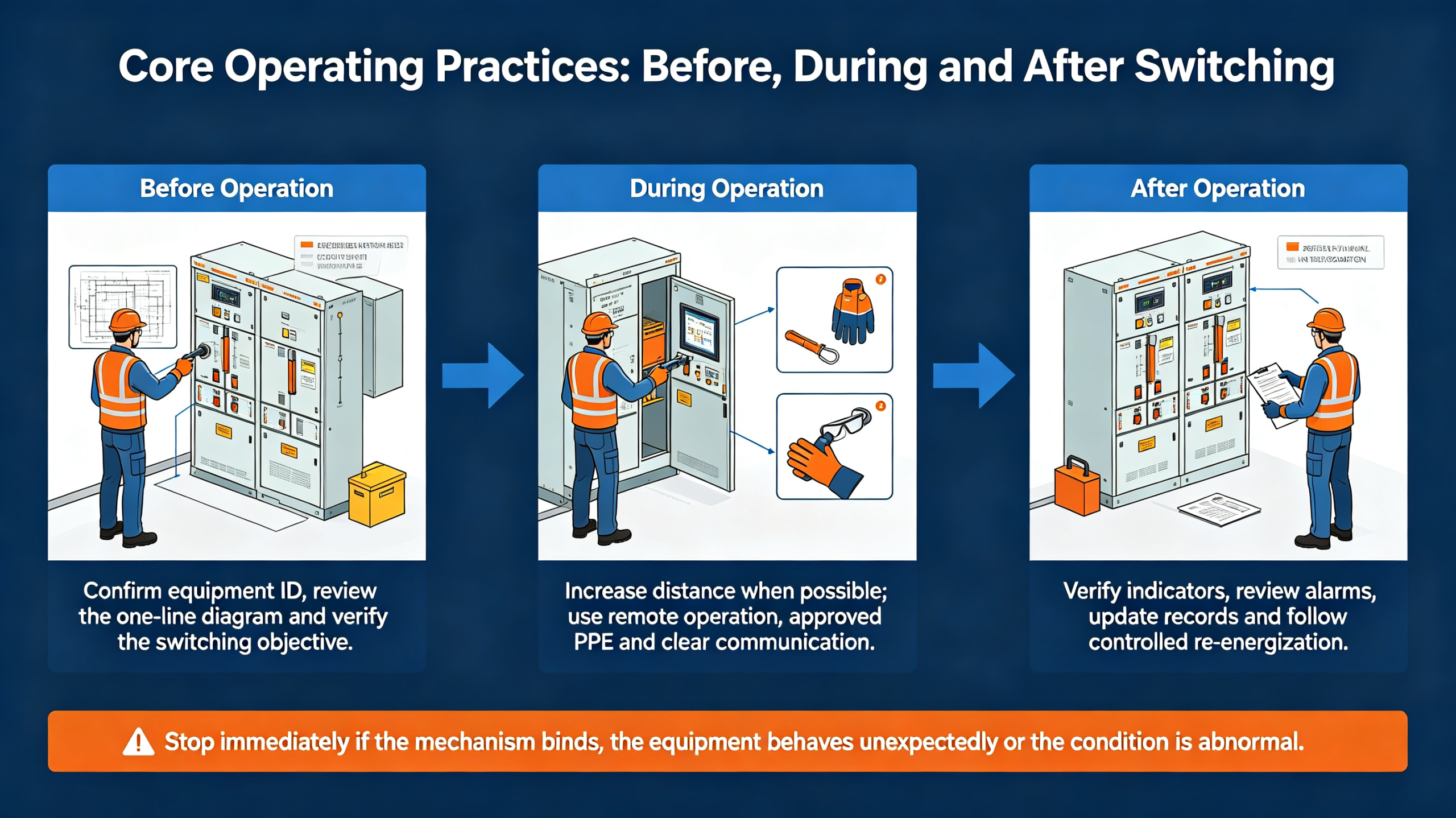
Safe operation begins before the switchgear handle, breaker control switch, or racking mechanism is touched. Operators should confirm the equipment identification, review the one-line diagram, verify the switching objective, and understand the consequences for downstream loads. For critical systems, a second qualified person or formal switching authority may be needed to reduce the chance of wrong-equipment operation.
Before operation, personnel should look for warning signs: missing covers, open doors, moisture, tracking, unusual noise, odor, damaged indicators, alarm conditions, failed heaters, or evidence of prior fault activity. If the equipment is not in normal condition, the standard should require a pause and further evaluation. NFPA 70E-style programs commonly distinguish between normal operation and tasks where the likelihood or severity of exposure increases, so condition matters as much as the task name.
During operation, the preferred method is often to increase distance from the hazard when the system design allows it. Remote open, close, or racking features can reduce exposure, but they do not remove the need for planning, communication, and correct setup. If manual operation is required, the operator should stand as directed by site procedure, use required PPE, keep unnecessary personnel clear, and stop immediately if the mechanism binds or the equipment behaves unexpectedly.
After operation, the result should be verified. Indicators should match the intended state, alarms should be reviewed, load changes should be understood, and documentation should be updated. If the task involved de-energized work, the absence of voltage must be verified with an appropriate test method before contact, and re-energization should follow a controlled release process.
Practical examples and common misconceptions
Medium voltage safety becomes clearer when standards are tied to real situations. The following examples show how written rules guide decisions in the field:
- Racking a drawout breaker:The procedure should confirm breaker status, compartment condition, control power, interlocks, PPE, remote racking options, and the approved position change.
- Opening a feeder for maintenance:The operator should follow a switching order, isolate all energy sources, apply lockout/tagout, verify absence of voltage, and apply grounds if required by the work plan.
- Responding to a trip:A trip should not be treated as a simple reset. The cause should be evaluated before reclosing, especially after fault, differential, ground fault, or protective relay operation.
- Inspecting energized gear:Visual inspection through windows or from a safe position may be allowed by procedure, but opening covers or defeating barriers changes the hazard profile.
- Using arc-resistant gear:Arc-resistant design can reduce exposure under specified conditions, but it is not a license to ignore doors, latches, ventilation paths, maintenance condition, or manufacturer instructions.
Common misconceptions include thinking that “closed doors mean no hazard,” that “experienced operators do not need a checklist,” or that “PPE makes energized work acceptable by default.” Standards should push decisions toward elimination, de-energization, distance, engineering controls, administrative controls, and PPE in a disciplined order.
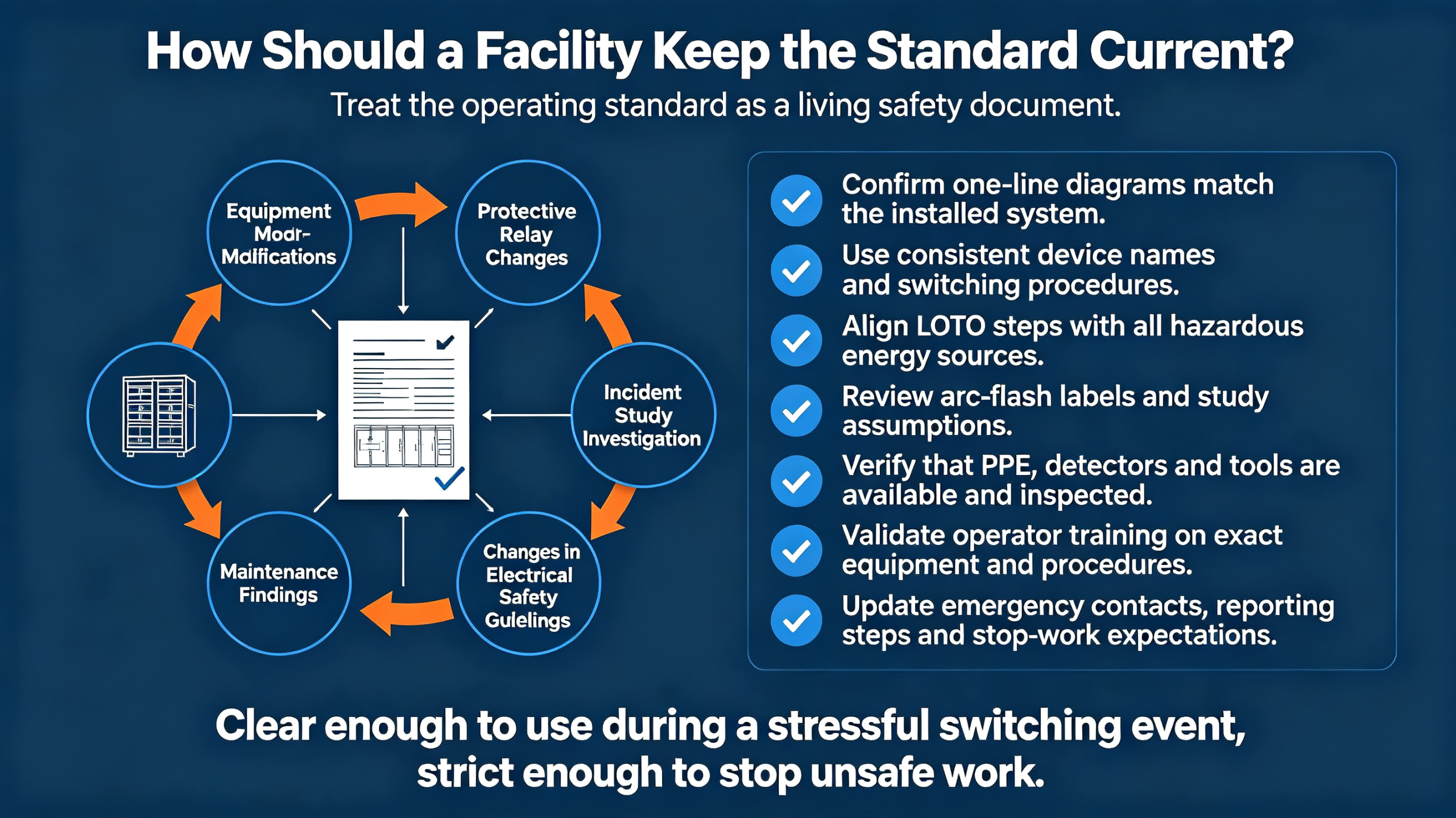
How should a facility keep the standard current?
A facility should treat its switchgear operation standard as a living safety document, not a binder created once and forgotten. Standards, equipment condition, staffing, fault current, protection settings, and operating modes can change over time. A review should occur after equipment modifications, protective relay changes, incident investigations, arc flash study updates, maintenance findings, or changes in applicable electrical safety guidelines.
A practical review checklist includes:
- Confirm that one-line diagrams match the installed system.
- Verify that labels, device names, and switching procedures use consistent equipment identification.
- Check that lockout/tagout steps align with all possible sources of hazardous energy.
- Review arc flash labels and study assumptions for accuracy.
- Confirm that PPE, voltage detectors, grounds, and operating tools are available and inspected.
- Validate that operators are trained on the exact equipment and procedures they use.
- Update emergency contacts, reporting steps, and stop-work expectations.
The best standard is clear enough to use during a stressful switching event and strict enough to stop unsafe work. For medium voltage systems, that balance is essential: written procedures, qualified people, maintained equipment, and disciplined verification work together to make safe operation repeatable.