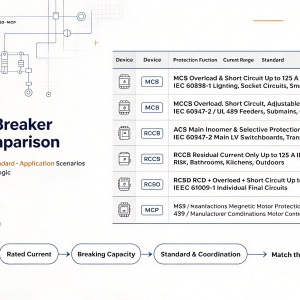
Choosing between MCB, MCCB, ACB, RCCB, RCBO, and MCP starts with one question: what fault are you protecting against? These circuit breaker types are all electrical protection devices, but they do not do the same job. This guide gives an MCB, MCCB, ACB, RCCB, RCBO, MCP full comparison table: current range, standard, application scenarios, and the practical selection logic behind each option.
Which circuit breaker type should you choose?
Choose an MCB for final small circuits, an MCCB for larger feeders, an ACB for main low-voltage switchboards, an RCCB for residual-current shock protection where separate overcurrent protection already exists, an RCBO where residual-current and overcurrent protection are needed in one device, and an MCP for motor short-circuit protection as part of a motor starter assembly. Standards matter because they define the tested scope: IEC 60898-1 covers household and similar AC MCBs up to 125 A, while IEC 60947-2 covers low-voltage circuit breakers for skilled-person applications up to 1,000 V AC or 1,500 V DC. (webstore.iec.ch)
Full comparison table
| Device | Main protection function | Typical current range / scope | Common standard reference | Best application scenarios | Key limitation |
| MCB | Overload and short-circuit protection | Up to 125 A under IEC 60898-1 scope | IEC 60898-1 | Lighting, socket circuits, small distribution boards | Not usually the best choice for high fault levels or large feeders |
| MCCB | Overload, short-circuit, often adjustable trip protection | Manufacturer ranges vary; examples include 16–1600 A and frame sizes up to 3000 A | IEC 60947-2 / UL 489 by market | Feeders, submains, generators, larger equipment panels | Bigger and costlier than an MCB; needs proper setting coordination |
| ACB | Main incomer, feeder, selective short-time protection | Common low-voltage ACB families reach high current ratings, with IEC-rated examples up to 6300 A | IEC 60947-2 | Main LV switchboards, transformers, large commercial and industrial distribution | Not suitable for small branch circuits; requires engineered switchgear space |
| RCCB | Residual-current / earth-leakage protection only | IEC 61008-1 scope: up to 125 A, no integral overcurrent protection | IEC 61008-1 | Shock-risk protection, bathrooms, kitchens, outdoor circuits, grouped RCD protection | Must be paired with MCB/MCCB/fuse for overload and short circuit |
| RCBO | Residual-current plus overload and short-circuit protection | IEC 61009-1 scope: up to 125 A and short-circuit capacity up to 25 kA | IEC 61009-1 | Individual final circuits where nuisance shutdown must be limited | More expensive per circuit than one shared RCCB plus MCBs |
| MCP | Instantaneous magnetic short-circuit protection for motors | Product-specific; selected by motor hp, voltage, FLA, and starter combination | UL 489 / manufacturer-listed combinations | Motor control centers, pump panels, compressor starters | Magnetic-only MCPs need separate overload protection |
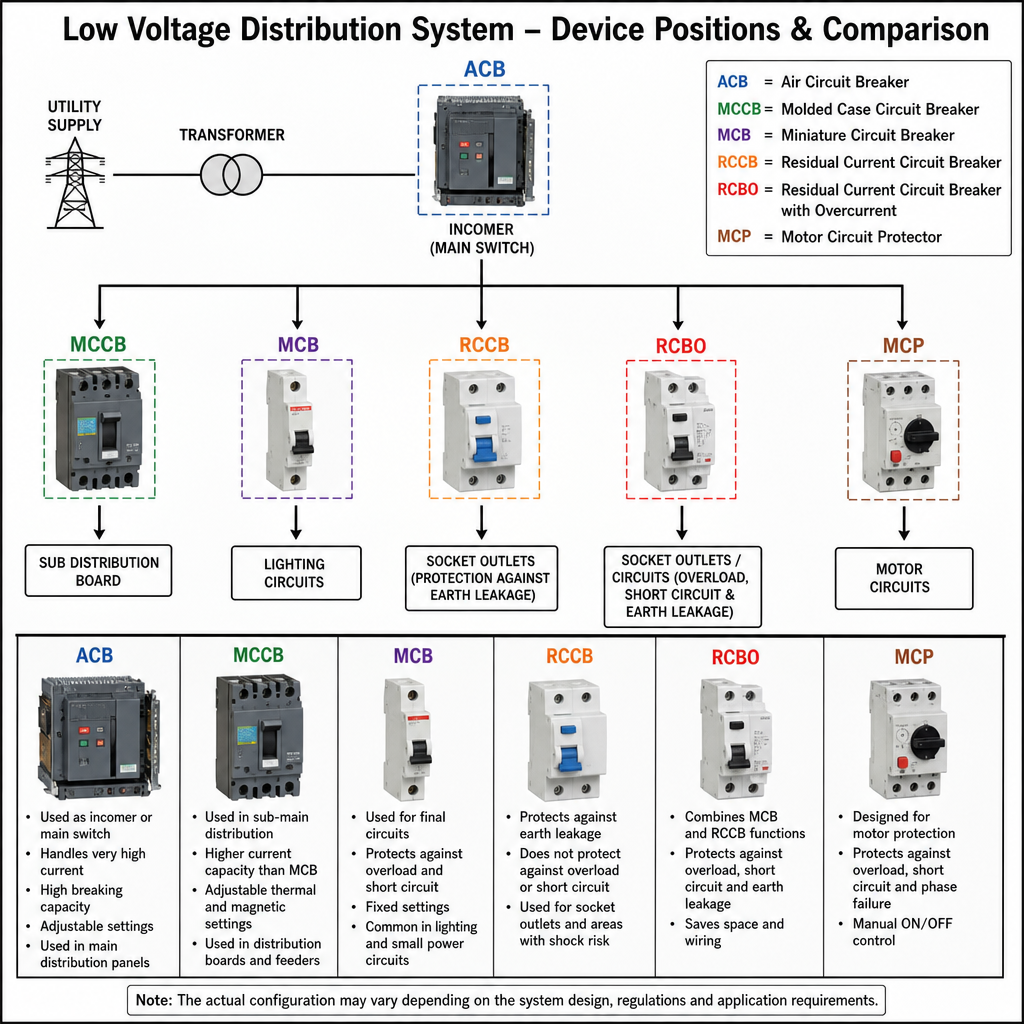
Protection function and standard fit
The biggest mistake is treating every breaker as interchangeable. An MCB and MCCB both protect against overcurrent, but the MCCB usually belongs where load current, fault level, adjustability, or panel duty exceeds the practical role of an MCB. For MCB vs MCCB decisions, check rated current, breaking capacity, trip curve, pole count, installation standard, and whether the downstream cable can be protected at the selected setting.
An RCCB is different because it does not replace overcurrent protection. It detects residual current, so it is selected for electric-shock and earth-leakage protection, not cable overload protection. RCBO uses are strongest when each circuit should trip independently: for example, one faulty outdoor circuit should not shut down an entire floor.
An MCP is also specialized. Schneider Electric describes magnetic-only motor circuit protectors as instantaneous-trip breakers designed for short-circuit protection in combination controllers with motor overload protection; the thermal overload function is handled separately. (productinfo.se.com)
MCB vs MCCB: where the decision changes
The MCB vs MCCB choice changes when the circuit stops looking like a small final circuit and starts acting like a feeder. If the load is small, predictable, and inside a domestic or light-commercial distribution board, an MCB is usually the cleanest option. If the circuit feeds machinery, a sub-distribution board, a larger cable run, or a higher fault level locati0n, an MCCB gives more room for interrupting capacity, trip adjustment, and coordination.
Use this simple rule of thumb:
- Choose MCBwhen the rating, breaking capacity, and curve match a final circuit.
- Choose MCCBwhen the circuit needs higher capacity, adjustable protection, or feeder-level coordination.
- Choose ACBwhen the breaker is part of main LV switchgear and selectivity with downstream MCCBs matters.
Which option is safest for people and equipment?
No single device is “safest” in every case; safety comes from matching the device to the fault. For people, RCCBs and RCBOs add residual-current protection intended principally for shock-hazard protection in household and similar use. For equipment and conductors, MCBs, MCCBs, ACBs, and MCPs address overcurrent or short-circuit faults, depending on circuit size and application. (webstore.iec.ch)
For the best practical outcome, combine protections correctly. A motor feeder may need short-circuit protection, overload protection, isolation, and control, not just one breaker. A socket circuit may need both overload protection and residual-current protection, which can be achieved with an MCB plus RCCB arrangement or a single RCBO.
Application scenarios by panel type
In a home or apartment distribution board, MCBs and RCBOs are common for final circuits, while RCCBs may protect groups of circuits. In a commercial panel, MCCBs often protect feeders, larger HVAC loads, and sub-panels, with RCBOs or RCCB arrangements used where residual-current protection is required. In an industrial LV switchboard, ACBs commonly sit at the main incomer or bus-tie position, MCCBs protect outgoing feeders, and MCPs appear in motor-control sections.
ACB applications are most convincing where service continuity and selective tripping matter. Because ACBs can be integrated into engineered switchgear with high ratings and coordinated downstream devices, they are normally selected by electrical designers rather than swapped like a branch breaker. Always confirm the local code, system earthing, prospective fault current, voltage, utilization category, and manufacturer datasheet before final selection.
Final selection checklist
Before specifying any of these circuit breaker types, verify:
- Fault type:overload, short circuit, earth leakage, motor inrush, or a combination.
- Rated current:match the load and cable, not just the connected equipment nameplate.
- Breaking capacity:must exceed the available prospective short-circuit current.
- Standard and approval:IEC, UL, or local certification must fit the market and installation.
- Coordination:upstream and downstream devices should trip in the intended order.
- Application:final circuit, feeder, main switchboard, residual-current protection, or motor starter.
For small circuits, start with MCB or RCBO. For feeders, compare MCCB ratings and settings. For main boards, consider ACB applications. For motors, use MCP only as part of a properly coordinated motor protection system.