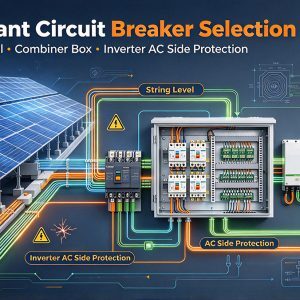
A safe PV plant depends on protection devices that match the electrical behavior of every part of the system: DC strings, combiner boxes, inverter inputs, and the AC side of the inverter. Solar circuit breakers are not simply “on/off” switches; they help isolate faults, support maintenance, and reduce the risk of overheating when selected and coordinated correctly. This guide explains practical circuit breaker tips for solar panel protection without replacing the need for a qualified designer, local code review, or manufacturer documentation.
What should a PV circuit breaker protect?
A PV circuit breaker should protect conductors, equipment, and service personnel by interrupting abnormal current and providing a safe means of isolation where required. In a solar plant, protection must account for the direction of power flow, available fault current, operating voltage, temperature, enclosure conditions, and whether the circuit is DC or AC. Good pv system safety starts by choosing devices for the actual circuit they serve, not by reusing generic breakers because the ampere rating looks similar.
Solar PV systems create conditions that are different from typical building loads. PV modules can continue producing voltage whenever light is present, DC arcs are harder to interrupt than AC arcs, and combiner boxes may collect current from multiple strings. On the inverter AC side, the breaker must coordinate with the inverter output, downstream panel, transformer, and utility interconnection requirements.
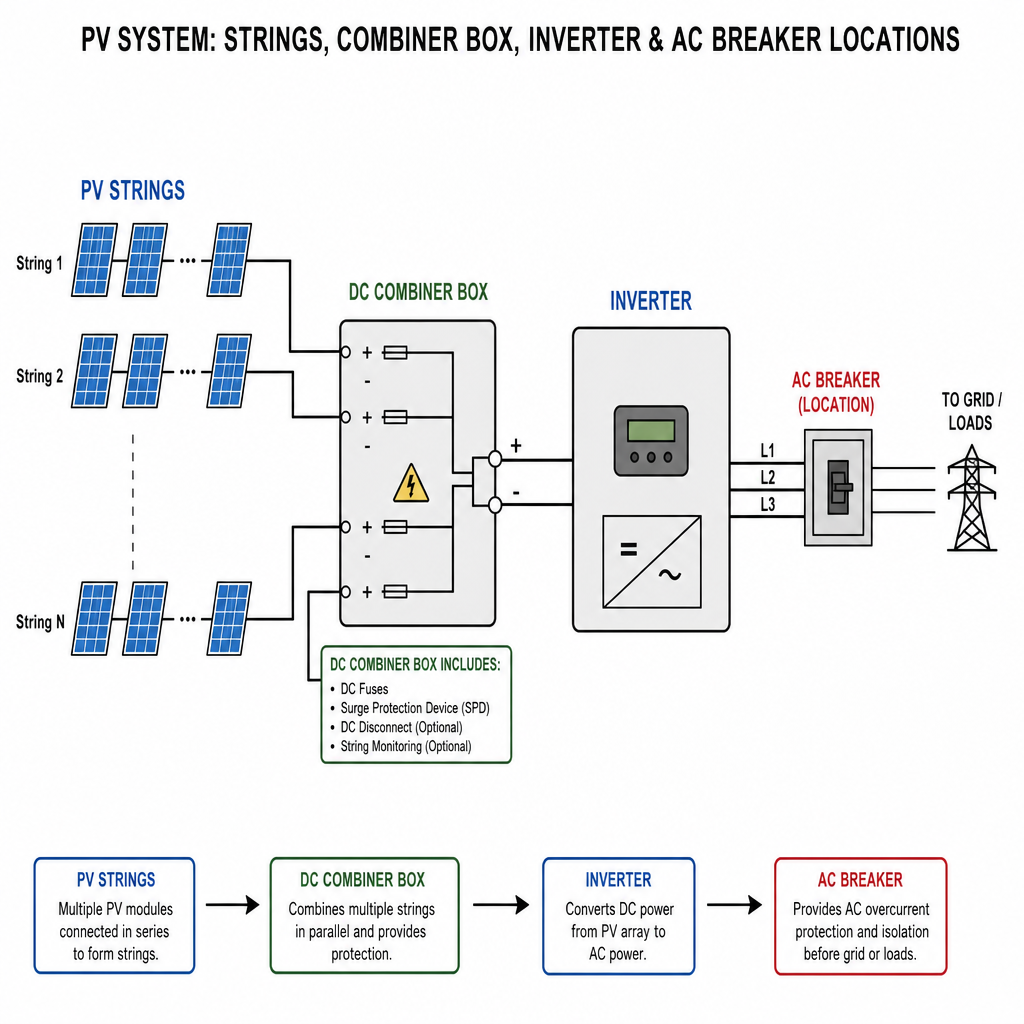
Protection points in a solar PV plant
Breaker selection becomes clearer when the system is divided into protection zones. Each zone has a different role, so one device type rarely suits every locati0n.
String-level protection
String-level protection is used where individual PV strings need isolation or overcurrent protection before they enter a combiner or inverter input. This is especially important when multiple strings are paralleled and a faulted string could receive backfeed from other strings. The device must be rated for the maximum DC voltage of the string and the expected current under operating and environmental conditions.
At this level, designers often consider whether fuses, breakers, or integrated inverter protection are appropriate. Breakers can offer resettable operation and switching convenience, but they must be specifically rated for PV DC use. A standard AC breaker is not a substitute for a DC solar breaker.
Combiner box protection
The combiner box brings multiple strings together, which makes it a critical point for solar panel protection. Protection may include string input breakers or fuses, a main DC disconnect, surge protection, monitoring, and terminals sized for the combined current. The breaker selected for the combined output must match the conductor ampacity, enclosure rating, system voltage, and available fault conditions.
A well-designed Combiner Box also supports practical maintenance. Clear labeling, safe spacing, touch-safe components, and logical grouping reduce mistakes during inspection or troubleshooting. Breaker selection should therefore consider not only electrical rating, but also how technicians will safely identify, isolate, and restore circuits.
Inverter input and DC disconnects
Some inverters include integrated DC switching and protection, while others require external devices. The key is to confirm what the inverter manufacturer requires for each input channel or maximum power point tracker. If external protection is needed, it must be compatible with the inverter’s voltage window, maximum input current, and grounding or bonding configuration.
Inverter AC side protection
Inverter AC Side Protection is focused on the output circuit from the inverter to an AC distribution panel, switchboard, transformer, or grid interconnection point. The breaker must be rated for AC voltage, continuous operating current, short-circuit conditions, and the type of panel or switchgear used. It may also need to coordinate with anti-islanding protection, utility disconnect rules, and downstream protective devices.
How do you size solar system breakers correctly?
Solar system breakers are sized by starting with the electrical source, then checking the conductor, equipment terminal, enclosure, and interrupting requirements. The breaker should not be chosen only from the inverter nameplate or module label; those values must be interpreted with applicable correction factors and the manufacturer’s instructions. When in doubt, the safest circuit breaker tips are to verify the full circuit design and avoid assumptions.
A practical selection process includes:
- Identify the circuit type.Confirm whether the breaker is for PV DC string circuits, combined DC output, inverter AC output, auxiliary power, or monitoring equipment.
- Confirm voltage rating.The breaker rating must exceed or match the maximum system voltage for that circuit, including cold-condition PV voltage on DC strings.
- Calculate operating current.Use the correct source current, expected continuous loading, and any required design margins.
- Match conductor protection.The breaker must protect the cable insulation and ampacity after temperature, conduit, grouping, and installation conditions are considered.
- Check interrupting capacity.The device must be able to safely interrupt the available fault current at its installed locati0n.
- Verify DC or AC suitability.DC-rated solar circuit breakers and AC-rated breakers are not interchangeable unless the manufacturer specifically lists the device for the application.
- Review enclosure conditions.Heat, dust, moisture, altitude, and outdoor exposure can affect performance and may require derating or a different enclosure.
- Coordinate with other devices.Upstream and downstream protection should operate in a planned sequence rather than causing unnecessary plant-wide shutdowns.
Key ratings that matter
A breaker label contains more than an amp rating. For PV work, several ratings determine whether the device is appropriate.
- Rated current:The continuous current the breaker can carry under stated conditions.
- Rated voltage:The maximum circuit voltage for which the breaker is listed, separately for AC and DC where applicable.
- Interrupting rating:The maximum fault current the breaker can safely interrupt.
- Utilization category or application rating:Indicates suitability for specific switching or protection duties.
- Number of poles:Must match the circuit design, polarity, grounding method, and isolation requirements.
- Temperature rating:Must align with conductor terminals, ambient conditions, and enclosure heat rise.
- Polarity marking:Important for many DC breakers because incorrect wiring can reduce arc interruption performance.
These details are easy to overlook during procurement. A low-cost breaker with the right amp value but the wrong DC voltage rating can create a serious safety gap.
DC and AC breakers are different devices
DC breakers must interrupt current that does not naturally cross zero, which makes arc suppression more demanding. Many DC solar circuit breakers use specific internal arc chambers, magnetic blowout structures, or polarity-sensitive designs. That is why a breaker suitable for a building AC panel may be unsafe on a PV string or combiner output.
AC breakers, by contrast, are selected for alternating-current systems where voltage and current waveforms behave differently. On the inverter AC side, the breaker must suit the panelboard or switchgear, the inverter output characteristics, and the grid connection arrangement. Both device types can support pv system safety, but only when each is installed in the circuit it was designed to protect.
Common selection mistakes to avoid
PV protection problems often come from small assumptions made early in design or purchasing. Avoid these errors:
- Using an AC-only breaker on a DC PV circuit.
- Selecting by amperage while ignoring voltage and interrupting rating.
- Forgetting temperature correction for rooftop, outdoor, or enclosed equipment.
- Oversizing a breaker beyond the conductor’s safe carrying capacity.
- Mixing brands or accessories in a way not approved by the manufacturer.
- Installing polarity-sensitive DC breakers backward.
- Assuming inverter-integrated protection eliminates every external protection requirement.
- Leaving combiner box circuits poorly labeled, making safe isolation difficult.
A practical checklist before installation
Before energizing the system, review the protection scheme as a complete design rather than as separate parts. Confirm that drawings, labels, breaker ratings, cable sizes, and inverter documentation agree with one another. This final check is one of the simplest ways to improve solar system reliability and service safety.
Use this checklist:
- Breakers are listed or rated for the intended PV DC or AC application.
- Maximum voltage and current have been checked for real site conditions.
- Conductors, terminals, lugs, and enclosures are compatible.
- Combiner Box inputs and outputs are clearly identified.
- Inverter AC Side Protection matches the inverter and distribution equipment.
- Fault-current and coordination requirements have been reviewed.
- Disconnecting means are accessible and labeled.
- Installation has been inspected by qualified personnel under applicable codes.
Selection supports safety, uptime, and maintainability
Circuit Breaker Selection for Solar PV Plant String Level, Combiner Box, Inverter AC Side Protection is a design decision that affects the whole plant lifecycle. Correctly chosen breakers help isolate faults, protect cables and equipment, simplify troubleshooting, and support safer maintenance. Poor selection can lead to nuisance trips, damaged equipment, or unsafe fault conditions.
The best approach is systematic: define the circuit, calculate the electrical conditions, choose certified devices for that exact duty, and confirm compatibility with the inverter, combiner, conductors, and local requirements. When solar circuit breakers are treated as engineered protection devices rather than commodity parts, they become a key part of dependable pv system safety.