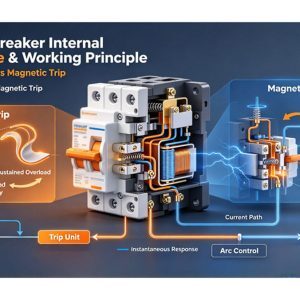
A circuit breaker is an automatic switching device that protects an electrical circuit by stopping current flow when a fault or overload occurs. Its main job is simple: detect unsafe current, open its contacts, and isolate the problem before wiring, equipment, or people are put at greater risk. This breakdown explains the circuit breaker function, its internal parts, and the difference between thermal trip and magnetic trip action in clear, practical terms.
What does a circuit breaker do?
A circuit breaker interrupts abnormal current and can be reset after the fault is cleared, unlike a fuse that must be replaced. In normal operation, current passes through the breaker contacts with minimal interruption. When the current becomes too high for too long, or rises suddenly during a short circuit, the breaker mechanism releases and separates the contacts.
That makes circuit breakers one of the most important electrical safety devices in homes, commercial panels, industrial switchgear, generators, and control systems. They protect cables and connected equipment from overheating, reduce fire risk, and provide a controlled way to disconnect power for maintenance.
Defining characteristics of a circuit breaker include:
- Current-carrying contactsthat stay closed during normal operation.
- A trip unitthat senses overloads or short circuits.
- An operating mechanismthat opens the contacts quickly when tripped.
- Arc control partsthat manage the electrical arc formed as contacts separate.
- A resettable handle or motorized mechanismthat allows reuse after inspection.
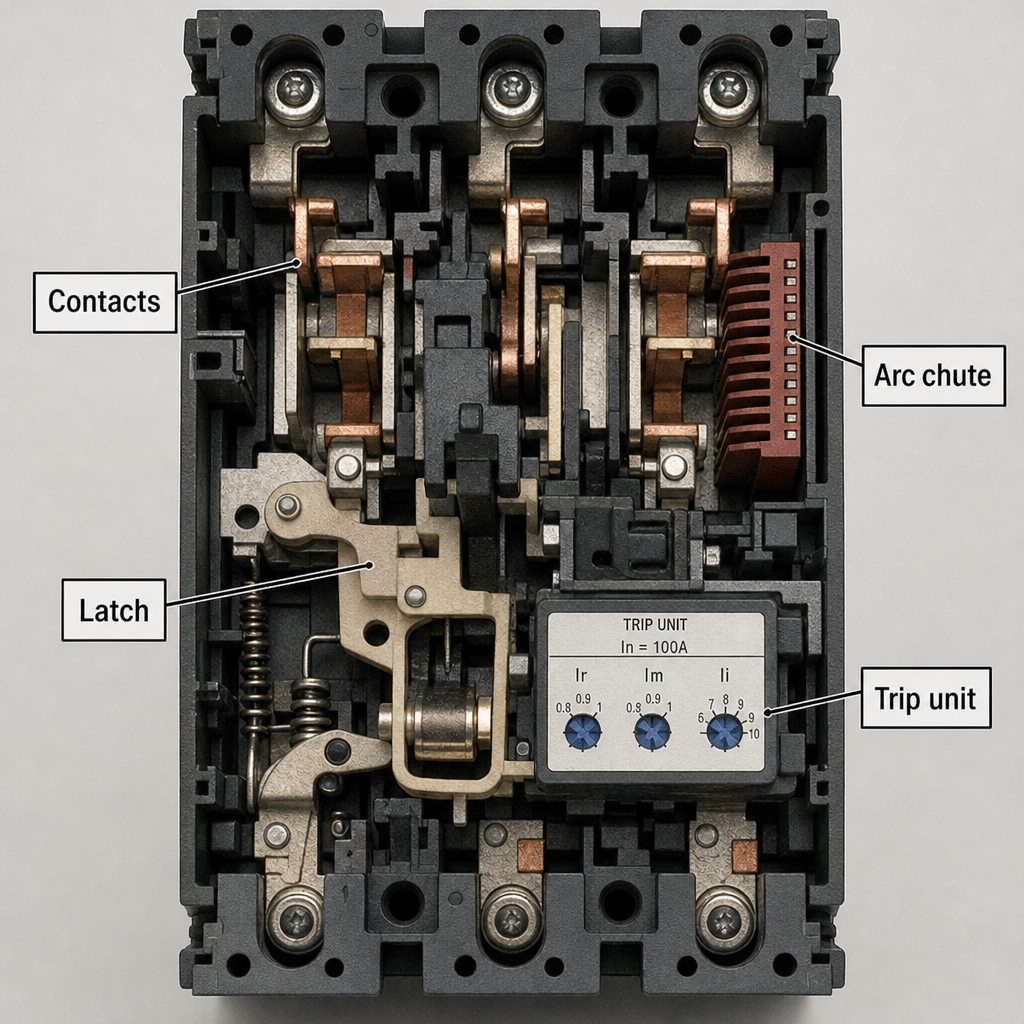
The internal structure of a circuit breaker
Although designs vary by rating and application, most circuit breakers share the same core structure. The outer case provides insulation and mechanical protection. Inside, fixed and moving contacts form the conductive path. A spring-loaded mechanism keeps the contacts closed during normal service and snaps them open during a trip.
The trip unit is the “decision-making” part. In a basic breaker, it may include a bimetal strip for thermal overload protection and an electromagnetic coil for instantaneous short-circuit protection. In larger breakers, electronic trip units may monitor current through sensors and trigger the mechanism with more adjustable settings.
Arc extinction is also essential. When contacts open under load, electricity can continue briefly through an arc. Arc chutes, splitter plates, magnetic blowout paths, or compressed air movement help stretch, cool, and divide the arc until it dies out safely.
How does the circuit breaker working principle operate?
The circuit breaker working principle is based on detecting abnormal current and mechanically opening the circuit. During normal load, the breaker remains closed and carries current through its conductive path. During an overload or fault, the trip system releases a latch, stored spring energy separates the contacts, and the arc-control system extinguishes the arc.
The exact sensing method depends on breaker type. Small low-voltage breakers commonly use thermal-magnetic protection. Air circuit breakers and generator circuit breakers may use more advanced trip units, closing mechanisms, protection relays, and arc-quenching arrangements because they handle higher currents and more demanding operating conditions.
A simple operating sequence looks like this:
- Normal current flowsthrough the line terminal, contacts, trip element, and load terminal.
- Fault current or overload appearsbecause of excess load, insulation failure, or short circuit.
- The trip unit reactsthermally, magnetically, electronically, or through a relay signal.
- The latch releasesand the stored-energy mechanism drives the contacts apart.
- The arc is controlledby arc chutes, air flow, magnetic force, or other extinguishing methods.
- The breaker remains openuntil the fault is checked and the device is reset or reclosed.
Thermal trip action handles overloads
A thermal trip protects against sustained overcurrent. It usually relies on a bimetal strip made from two metals that expand at different rates when heated. As overload current flows for a period of time, the strip bends. When it bends far enough, it releases the trip mechanism and opens the breaker.
This action is intentionally time-delayed. A motor starting surge, transformer inrush, or temporary load increase may be higher than normal for a short moment without being dangerous. Thermal tripping allows brief, acceptable surges while still responding when current remains excessive long enough to overheat conductors.
Thermal trip behavior is commonly described as inverse-time operation: the higher the overload, the faster the breaker trips. It is best suited for overload protection, not instant short-circuit clearing.
Magnetic trip action handles short circuits
A magnetic trip responds to very high current almost instantly. It uses an electromagnetic coil or solenoid. Under normal current, the magnetic force is not strong enough to release the mechanism. During a short circuit, current rises sharply, the magnetic field becomes strong, and the armature pulls in to trip the breaker.
This fast response is important because short-circuit current can reach damaging levels quickly. Magnetic tripping limits the time that conductors, busbars, contacts, and connected equipment are exposed to severe fault energy. In thermal-magnetic breakers, the magnetic element handles the sudden fault while the thermal element handles slower overloads.
Thermal trip vs magnetic trip at a glance:
| Feature | Thermal Trip | Magnetic Trip |
| Main purpose | Overload protection | Short-circuit protection |
| Sensing method | Heat bends a bimetal strip | Fault current creates strong magnetism |
| Response speed | Delayed | Very fast |
| Best for | Long-duration excess current | Sudden high fault current |
| Typical behavior | Inverse-time | Instantaneous or near-instantaneous |
Air circuit breaker and generator circuit breaker principles
The air circuit breaker working principle uses air as the arc-extinguishing medium. In an ACB, contacts open in air, and arc chutes divide and cool the arc until it is extinguished. The acb circuit breaker working principle is common in low-voltage main distribution boards, large feeders, and industrial switchgear where high current interruption and maintainability are important.
The generator circuit breaker working principle is similar in the broad sense: detect a fault or abnormal condition, separate contacts, and extinguish the arc. However, generator applications are more specialized because the breaker may need to coordinate with generator protection, synchronization, reverse power protection, and system stability requirements. For that reason, generator breakers are usually selected and set by qualified professionals using the generator, transformer, and network data.
Practical examples and common misconceptions
Understanding how a breaker trips helps with safer troubleshooting, but it should not replace proper electrical testing or professional inspection. A breaker that trips repeatedly is not “too sensitive” by default. It may be warning that the circuit is overloaded, a device is faulty, or insulation has failed.
Common use cases include:
- Home branch circuits:protecting lighting, receptacles, and appliances from overload or short circuit.
- Motor circuits:allowing brief starting current while tripping on sustained overload or faults.
- Main distribution panels:isolating larger feeders and protecting downstream equipment.
- Generator output protection:disconnecting the generator from the system during unsafe conditions.
- Industrial switchgear:coordinating protection across multiple breakers and loads.
Common misconceptions to avoid:
- A breaker does not prevent every shock hazard; additional protection may be required.
- A higher-rated breaker is not an upgrade unless the wiring and system are designed for it.
- Resetting a breaker repeatedly without finding the cause can make a dangerous condition worse.
- Thermal and magnetic trips are not competitors; they solve different protection problems.
Key takeaway
A circuit breaker is a resettable protective switch designed to open a circuit when current becomes unsafe. Its internal structure combines contacts, a trip unit, a latch mechanism, springs, terminals, and arc-control components. Thermal trip protection responds to overheating caused by sustained overload, while magnetic trip protection responds rapidly to short circuits. If you are building notes or a circuit breaker working principle PDF, the simplest summary is this: thermal trip protects against “too much current for too long,” and magnetic trip protects against “far too much current right now.”