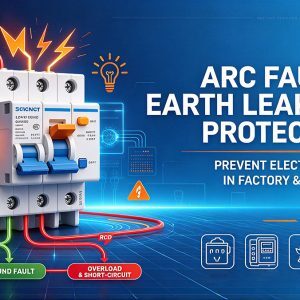
Arc fault and earth leakage protection address different electrical hazards: dangerous arcing and current escaping its intended path. Used alongside overload and short-circuit protection, they help reduce electrical fire and shock risks in homes and suitable factory circuits. Neither replaces sound wiring, correct installation, or maintenance; effective protection requires these layers to work together. (osha.gov)
What is arc fault protection, and why is it needed?
Arc fault protection detects electrical patterns associated with hazardous arcing and disconnects the protected circuit. An arc occurs when electricity crosses an unintended gap, potentially producing heat that damages insulation or ignites nearby material. Unlike a straightforward overload, some arcing faults draw too little current to operate a conventional breaker promptly. (osha.gov)
An arc fault circuit interrupter, or AFCI, adds fault detection beyond conventional overcurrent protection. In IEC-based markets, related devices are commonly called arc fault detection devices, or AFDDs. Product capabilities and installation rules differ, so these names should not be treated as proof that two devices are interchangeable. (se.com)
Series and parallel arc faults
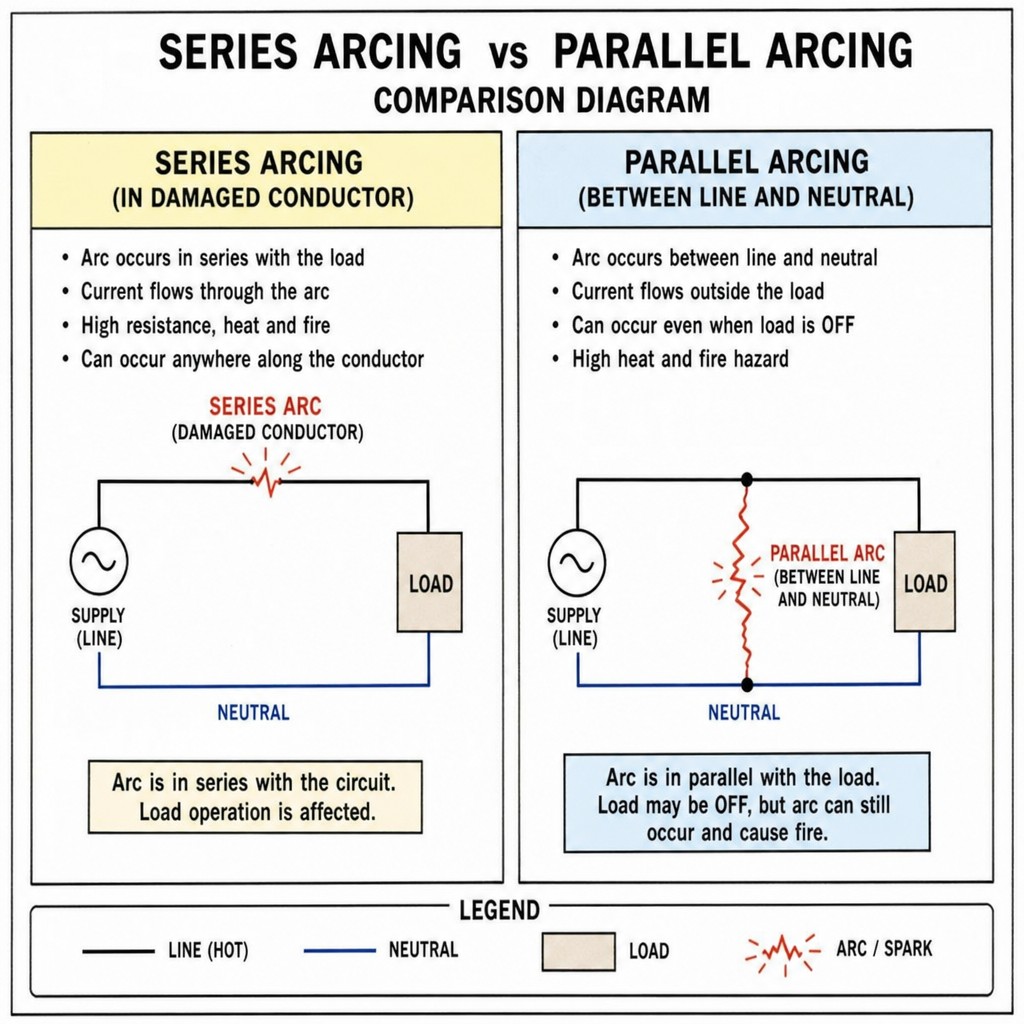
A series arc develops along a conductor’s normal current path, such as at a damaged wire or defective connection. Because the connected load limits current, the fault may remain below the breaker’s overload threshold. A parallel arc occurs between conductors, such as line and neutral, or line and protective earth; whether other protection operates depends on the fault path and current. (eaton.com)
For example, a cord pinched beneath an appliance can deteriorate without creating an immediate high-current short circuit. Arc fault circuit interrupter protection is designed to recognize hazardous arcing characteristics rather than relying solely on excessive current. That distinction explains why installing a higher-rated ordinary breaker is not a solution to an arcing problem. (eaton.com)
How does earth leakage protection differ from arc fault protection?
Earth leakage protection detects current imbalance between the conductors supplying and returning electricity. An imbalance can indicate that current is flowing through an unintended route, including damaged insulation, grounded metalwork, or a person. Arc fault protection instead looks for characteristics of hazardous arcing; one function does not automatically provide the other. (osha.gov)
In the United States, ground-fault circuit interrupters, or GFCIs, provide personnel protection against ground-fault shock hazards. Internationally, residual current device, or RCD, is a broader term covering devices with different characteristics and purposes. Do not assume every earth leakage device offers the same level of personal protection as a personnel-rated GFCI. (osha.gov)
Earth leakage protection also has limits. A GFCI cannot reliably protect someone touching line and neutral simultaneously when current remains balanced through the device. Likewise, an RCD may not detect a line-to-neutral arc because no current escapes the monitored conductors. (osha.gov)
The protection layers and their limits
Circuit protection works best when each device has a clearly understood job. An ordinary breaker primarily addresses excessive current; arc fault and residual-current functions address additional hazards. Some products integrate several functions, while others require coordinated separate devices. (osha.gov)
| Protection function | Main hazard addressed | Important limitation |
| Защита от перегрузки | Excessive sustained current that can overheat conductors | Low-current arcing may remain undetected |
| Защита от короткого замыкания | High fault current between conductors | Not every dangerous fault produces high current |
| AFCI or AFDD | Hazardous arcing within its detection scope | Does not automatically include personnel-rated leakage protection |
| GFCI or suitable RCD | Current escaping the intended circuit | Does not detect every arc or prevent every shock |
These distinctions follow the different detection principles; select the actual device by its documented protective functions. (osha.gov)
Pay particular attention to terminology. A combination AFCI generally refers to protection against both series and parallel arcs, not necessarily combined AFCI and GFCI protection. A dual-function AFCI/GFCI breaker provides both functions; verify its labeling rather than relying on appearance or a test button. (se.com)
Applying protection in residences and factories
Residential priorities
A home assessment should examine both existing protective devices and wiring condition. Damaged cords, loose-fitting plugs, repeated trips, unusual buzzing, and discolored outlets deserve attention even when appliances still operate. A new protective breaker cannot repair deteriorated insulation or an overheated connection. (cpsc.gov)
Ask a qualified electrician to review circuit protection alongside these warning signs. Include circuits serving moisture-prone areas in the discussion because ground-fault shock protection is especially important where water increases exposure. Treat an upgrade as an opportunity to identify defects, not simply exchange breakers. (osha.gov)
Factory and workshop priorities
Factories need an equipment-specific assessment rather than a blanket residential solution. Three-phase supplies, motor drives, and power electronics can change the protective device requirements. For example, some three-phase variable-frequency drives require Type B residual-current protection because of the fault-current waveforms they can produce; follow the particular equipment manufacturer’s instructions. (eaton.com)
Review suitable final circuits for arc fault protection, particularly where combustible materials raise the consequences of ignition. Do not assume a residential AFCI is suitable for a machine feeder or industrial distribution system. Keep this review separate from workplace arc-flash safety: qualified personnel, energy-control procedures, and verification of de-energization remain essential. (eaton.com)
How should you choose suitable circuit protection?
Choose protection by matching the hazard, electrical system, equipment instructions, and applicable installation requirements. A device should not be selected solely because its current rating matches the old breaker. Have a qualified electrician or electrical engineer document the required functions and confirm suitability before installation. (eaton.com)
Use this checklist to guide that discussion:
- Define the objective:Distinguish overload, short-circuit, arcing, personnel shock, and equipment earth-fault protection instead of treating them as interchangeable.
- Confirm compatibility:Ask which devices are approved for the panel and appropriate for the circuit’s supply and load.
- Check residual-current characteristics:Identify whether connected electronics or drives require a particular RCD type; do not select sensitivity or waveform response by guesswork.
- Verify combined functions:Establish whether a proposed device includes overcurrent protection, arc fault protection, leakage protection, or only some of them.
- Plan testing and diagnosis:Confirm the test procedure, trip indications, and response when a device fails its check. (com)
For factory projects, request a written protection schedule identifying each circuit and its connected equipment. This gives maintenance staff a practical reference when loads change and helps prevent a future replacement from removing an intended protective function.
Installation, testing, and electrical safety tips
Electrical installation and fault investigation belong with qualified personnel. In workplaces, appropriate energy-control procedures and verification of de-energization are fundamental precautions. Do not open a panel or attempt live troubleshooting simply because a breaker has tripped. (cdc.gov)
After installation, follow the device’s testing instructions and retain them with the circuit records. CPSC guidance calls for monthly AFCI testing; arrange tests so occupants or operators know that power will be interrupted. A successful test is useful, but it does not establish that every cable and appliance is defect-free. (cpsc.gov)
Adopt these everyday precautions:
- Record repeated trips.Note which equipment was operating and report recurring interruptions for investigation.
- Remove visibly damaged cords from service.Cracked insulation and loose plugs are warning signs, not cosmetic defects.
- Avoid permanent extension-cord arrangements.Have inadequate outlet provision reviewed rather than extending temporary wiring indefinitely.
- Never increase a breaker rating to stop trips.An overrated protective device can leave branch-circuit wiring inadequately protected. (gov)
Burning odors, sparks, electrical shocks, and hot or discolored fittings require prompt action. Stop using the affected equipment and obtain qualified help; where there is immediate danger or fire, leave the area and contact emergency services. Do not repeatedly reset protection while warning signs remain. (cpsc.gov)
The practical goal is layered protection, not a promise that electrical fires become impossible. Match arc fault, earth leakage, and overcurrent functions to the installation, then support them with inspection, testing, and timely repairs. That approach addresses more hazards than relying on any single breaker technology. (osha.gov)